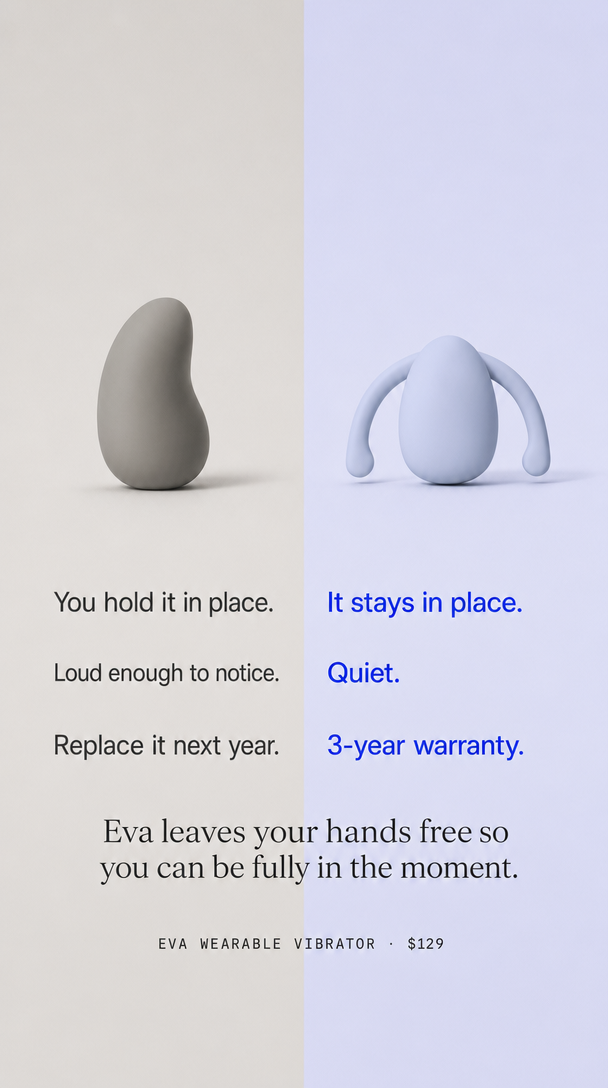
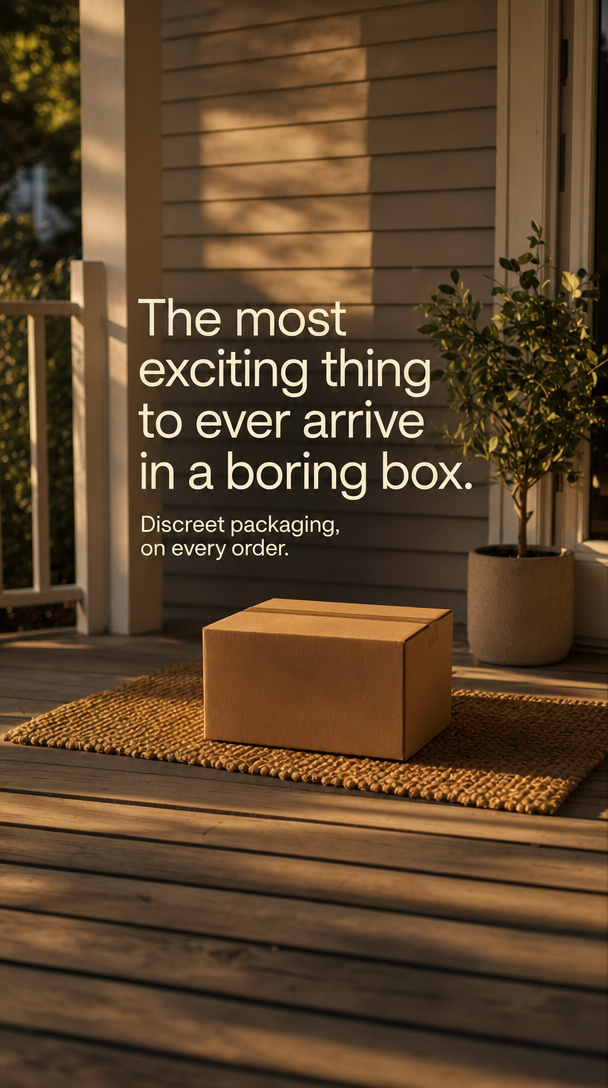
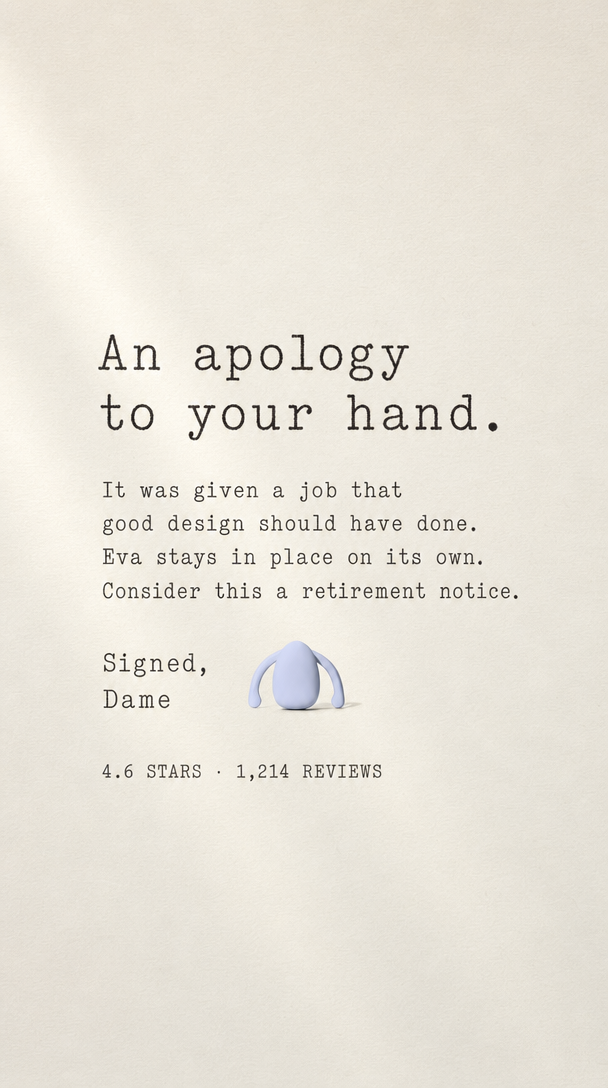
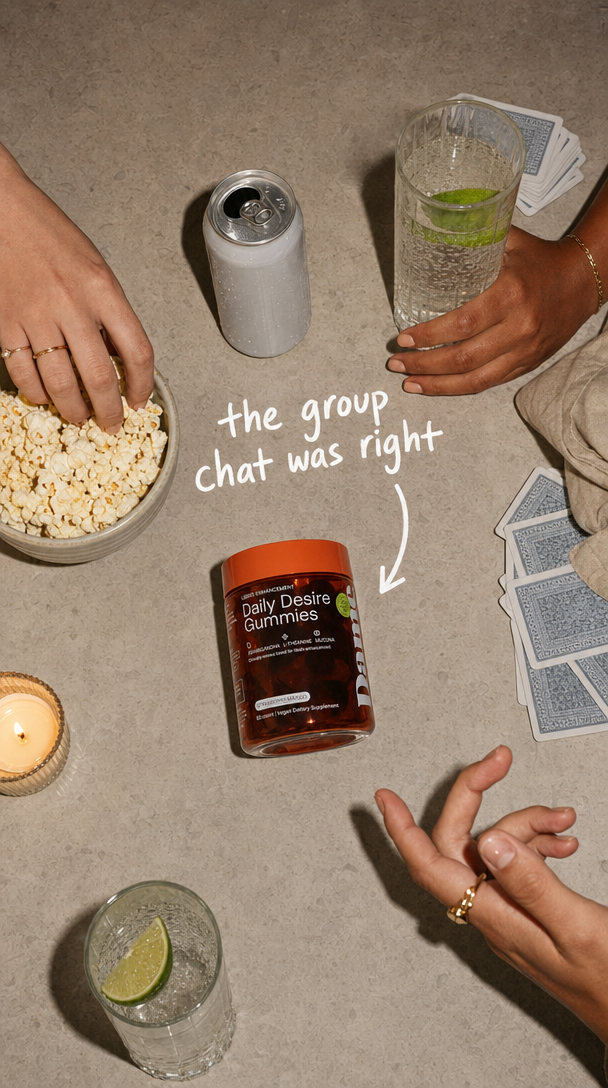
You're back on Meta after years locked out of a restricted category, scaling again, sold out on Valentine's Day, and the gummies relaunched the day of our call. The bottleneck now is content volume, in a category where most creative can't even clear review. The 14 specs on this page are phase-one compliant by design.
$80K/mo on Meta10 to 15 statics/week in-house todayTwo SKUs carrying the accountMeta first. Month to month.
Compliant first. Vague is a feature. Statics scout, video scales.
No Ad Library pull exists for Dame. Here is what does.
Your official page can't run ads, so the account lives in dummy accounts and there is no brand-level Ad Library history to tag. What we have instead is the market: our swipe-file digest, re-run this morning, August 19, 2026, covering 181 impressions-ranked active statics across 95 DTC brands, tagged by format family. It shows which formats are earning impressions today, against the single-format monoculture most restricted-category accounts ship.
Share of the format's ads sitting in their brand's top 5 by impressionsMedian position = where the format's ads rank inside a brand's active set (lower is better)
Offer / promotion
68% top-5median #2
Before & after
75% top-5median #3.5
Product hero
65% top-5median #4
Negative marketing
60% top-5median #5
Us vs. them
50% top-5median #5.5
Testimonials
4 for 4 in top-5median #2, small sample
One more signal: headline formats are the volume king at 32% of all active statics, and in this morning's run they rank too (median #5). The crowd runs them because they work, which is exactly why differentiation lives in the other families. Most restricted-category accounts ship one format on repeat; the 14 specs cover 11 distinct format families, weighted to where the impressions concentrate.
Every format family above maps to a spec on the work tab: the product heroes, the native UI overlay, the comparison split, the review proof, all phase-one compliant.
Edie's own words from August 19, and how the engagement is built around each one.
"We would just love to have more video content… we just want to find a way to get more content essentially."
Edie · on the call
Concept math answers this directly: every 6 statics trade for 1 scripted video inside the same monthly total, mixed any way you want. Statics open the persona cheaply and fast; video scales whatever they find. More content, and the right kind first.
"We're in a restricted category… it's dummy accounts."
Edie · on the call
The playbook already exists: three phases of compliancy, a rejection log on every ad, and creative built vague-first so the account's rejection rate stays clean while volume ramps. We run this exact structure for other high-risk accounts today, at a 3% rejection rate.
"Our designer makes about 10 between 10 and 15… we've had the same winning actually, just got a new winning ad."
Edie · on the call
One winner carrying an $80K account is fragility, not luck. 14 net-new concepts a week beside your designer's output means the next winner is always already in test, and the account never depends on a single ad holding up.
"Would we just move everything to you guys? I feel like that would probably make more sense."
Edie · on the call
Creative is the engagement on this page. Media management is a toggle below, priced at 7% of spend, and the D2C tracking tab comes with it: NCPA, new vs. returning, LTV. Take it now or later; the creative engine works either way.
You said September. Kickoff to first delivery is 5 days, so a September 1 start means creative in the account the first week.
The examples tab has 48 pieces across 29 brands, statics and motion, from the same team that built your 14.
High-risk accounts don't fail on creative quality; they fail on review. So the loop starts vague on purpose, watches the account's signals, and earns its way toward more direct language. Statics test first because video consumes more test budget, and every ad is graded before it ships.
Phase one
Vague, compliant creative. No product-in-use, no explicit language, no faces. Everyone in high-risk hears "this talks to no one" at this stage; it is the price of a clean account, and the 14 specs on this page all live here.
Phase two
Watch the account's signals. A rejection log on every ad, plus approval-latency tracking: an ad that takes 30 minutes to approve is already in the red zone. One rejection means seven clean days before the account resets.
Phase three
Language opens up. As the rejection rate stays clean, the door opens to more direct verbiage and product presentation. How far a sex-tech brand can go is found empirically, not guessed.
Piece one · weight 0.5
Compliance log on every ad.
Every rejection recorded with the why, so the same mistake never runs twice. Approval latency tracked per ad, because slow approvals predict trouble before rejections do. The result is a rejection rate the account can scale on while your competitors relaunch dummy accounts.
Piece two · weight 0.2
Swipe-file gap re-runs.
With no brand-level Ad Library available, the market map above is the benchmark: 181 impressions-ranked active statics across 95 DTC brands, tagged by format family. Re-runs weekly on a cron so the format map never goes stale, and every new gap becomes a brief. Today's version ran the morning of this proposal.
Piece three · weight 0.3
Reviews and Reddit, mined weekly.
Named Okendo reviews from dame.com, r/sextoys sentiment, and the language of the Dame Labs community, mined for personas nobody is testing: the discretion-first buyer, the quality skeptic, the couple closing the gap. Explicit call-outs get written from that language.
The cadence: briefs Monday, your review by Wednesday, assets Friday. Everything runs through Slack with a dedicated project manager. Statics scout net-new personas and angles first; winners move to GIF, then video, because video always consumes more test budget on Meta.
Pricing
Three tiers. Your spend picks one.
Slide to your monthly Meta ad spend. The tier snaps in steps: Starter under $60K, Pro from $60K, Scale from $100K. At your $80K, Pro is where the engagement starts.
Every tier includes the full engine: gap-analysis briefs, 9-rubric copy refinement, Agent-10 grading on every render before delivery, the weekly cadence, swipe-file re-runs, and review plus social listening bundled.
Your monthly Meta ad spend
$80K/ month
$9,000 / mo creative
$30K$60K$100K$300K
Recommended for your $80K
Starter
$6,000/ mo
$30K to $60K/mo spend
8 unique concepts a week · 32 net-new ads/mo
$188 per ad
Recommended for your $80K
Pro
$9,000/ mo
$60K to $100K/mo spend
The Andromeda sweet spot.
14 unique concepts a week · 56 net-new ads/mo
$161 per ad
PAE-tested across 100+ formats · custom PAE-cluster dashboard
Recommended for your $80K
Scale
$15,000/ mo
$100K to $300K/mo spend
30 unique concepts a week · 120 net-new ads/mo
$125 per ad
A concept is an entirely new ad, not a hook alt. 1 concept = 1 static; trade 6 statics for 1 scripted video, mixed any way inside your monthly total. In your terms: a 14-concept week can run 2 video concepts plus 2 statics, on top of everything your designer ships.
Add-on · media management
+$5,600/ mo (7%)
We run the buy
Done-for-you media buying with a custom MER dashboard, run inside the dummy-account structure you already use. Includes the D2C tab: NCPA, new vs. returning, LTV.
Add media management
Add-on · consulting
+$1,000/ mo
Media buying consulting
Biweekly review with our media team. We strategize, Lucid executes. Keeps your current media buyer in the seat with our account playbook behind them.
Add consulting
Add-on · landing pages
+$3,000/ mo
Persona-tuned landing pages
Persona-tuned LPs against winning concepts. Recent comp: roughly 30% CAC reduction from the layer alone.
Add landing pages
Your proposal total
$9,000/ month
PRO · 14 CONCEPTS A WEEK
Tier deliverables are fixed: 8, 14, or 30 unique concepts a week. Final start date locks on the close call.
↑Ramping past $100K takes you into Scale on the same per-creative economics. The calculator you saw on the call lives at selfmade.co; this page is that math, applied to Dame.
You said you'd get back to us in the next couple of days.
The proposal, the 14 specs, and the examples reel were live the same week as the call, for you and Alex both. You said September; a close call this week locks the start.
 .
.